

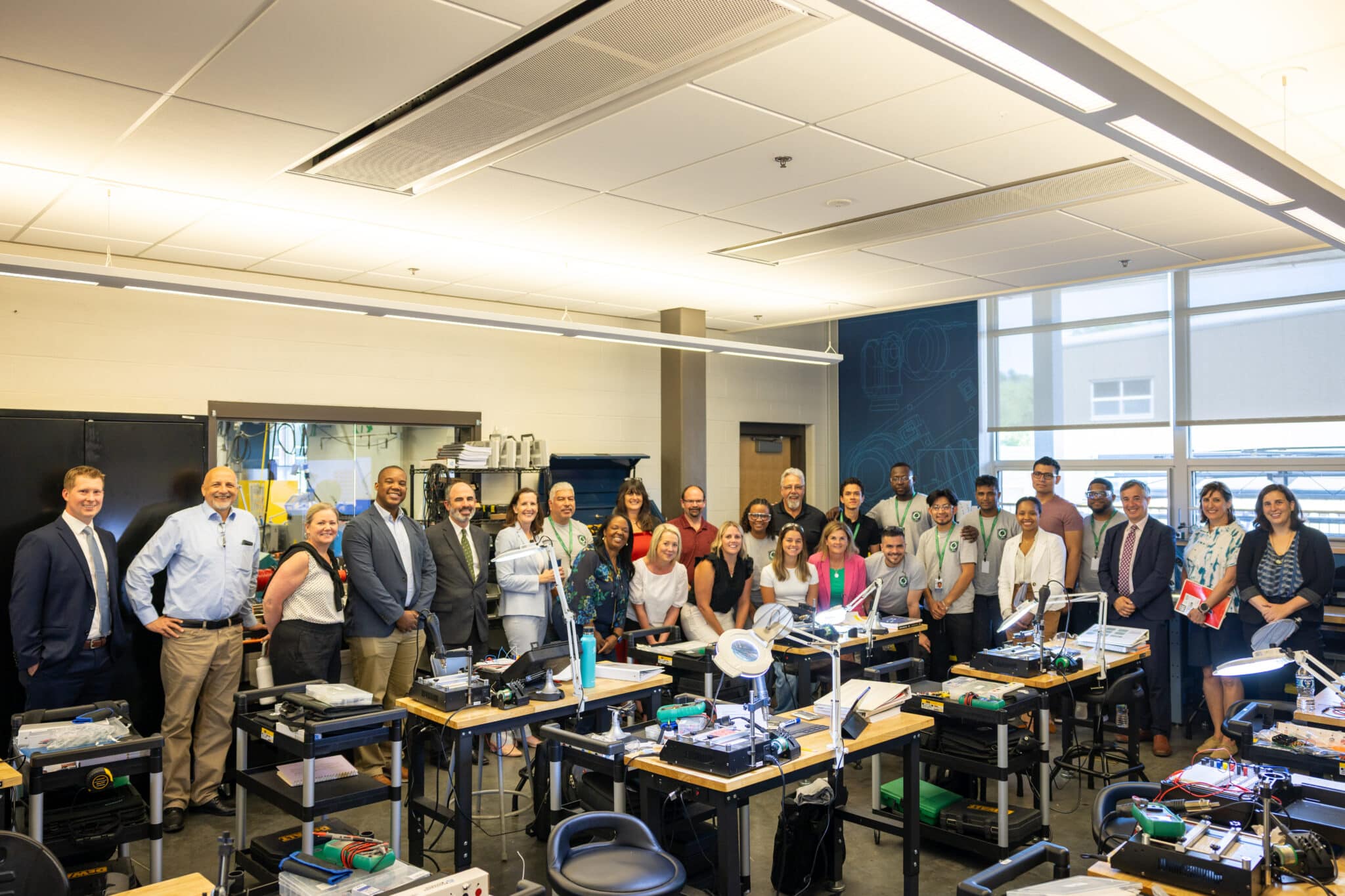


In 2025, demand for skilled workers in the trades, construction, and manufacturing sectors continues to rise. As the United States invests in bringing more manufacturing jobs back to our communities and modernizing infrastructure, preparing workers to fill these roles is critical. The gap is widening because more tradespeople are retiring due to the “silver wave,” while too few young people are choosing to follow in their footsteps, partly because traditional college degrees are often prioritized over trade credentials. Currently, manufacturers are able to fill only six out of every ten open positions.
The Workforce Skills Cabinet launched the Career Technical Initiative (CTI) in 2020 to create pipelines to meet this growing demand. CTI leverages existing vocational technical training facilities and equipment across the Commonwealth to provide training to unemployed and underemployed adults in the evenings and on weekends beyond traditional school hours to maximize public investment in vocational infrastructure. CTI participants choose from 20 different training pathways, including welding, automotive technology, HVAC, carpentry, plumbing, and electrical.
In addition to work readiness training, CTI provides case management and job placement support. Through partnerships between vocational schools, MassHire career centers and workforce boards, and employers, individuals looking for long-term careers are connected with businesses looking for skilled, credentialed workers.
CTI is funded annually through appropriations in the state budget. CTI has awarded nearly $70 million in grants to 34 grantees since 2020, and the return on investment is evident: With over $11 million in increased earnings among participants, and over $13 million in reduced government spending on public assistance, every $1 spent on CTI programming corresponds to $2.18 in economic value returned to Massachusetts.
Here are 5 things to know about the CTI program from its first 5 years:
1. More than 4,600 participants have enrolled in CTI programs.
Interest and participation in CTI programs have sharply risen over the last 5 years. CTI has helped add close to 5,000 skilled, credentialed tradespeople to the Massachusetts workforce, and will serve more than 7,200 total participants through December 2026.
2. 34 vocational technical schools run CTI programs.
CTI has grown from supporting 10 vocational technical schools in its first year to a total of 34 schools this year, demonstrating schools’ interest in making a difference in their communities and supporting local businesses.
3. Over 1/3 of CTI participants received public assistance and nearly half were unemployed at the time they enrolled into the program.
Facing barriers to sustainable, well-paying career pathways, many CTI participants were unemployed and receiving public assistance like unemployment insurance and SNAP benefits. After job placement, increased earnings and employment benefits reduce reliance on public assistance.4. 81% of CTI participants completed the program, of which 100% earned a credential.
In its first 5 years, 81% of CTI participants successfully completed their training program and out of those, 100% earned one or more credentials – typically a technical credential as well as a safety certification.5. 84% of participants are now employed in a training-related field, with a 51% increase in annual earnings.
As of 2024, CTI participants achieved an 84% job placement rate. Before participating in the CTI program, 48% of participants were unemployed. For participants who were underemployed when they started the program and secured jobs after completion, average annual earnings increased by $15,465 – a 51% raise.
In its first five years, the Career Technical Initiative has become a model of what effective workforce development can achieve. At a moment when the Commonwealth faces a widening skills gap and employers struggle to find qualified workers, CTI has strengthened both the workforce and the economy. CTI has trained thousands of new tradespeople, dramatically increased credential attainment, and helped participants achieve life-changing wage gains.
About CommCorp
Commonwealth Corporation is a quasi-public agency in Massachusetts overseen by the Executive Office of Labor and Workforce Development. Our mission is to foster workforce equity by delivering innovative and collaborative professional development solutions that help diverse communities and employers succeed. We administer and deliver a wide range of publicly and privately funded grant programs to create or expand education and training capacity for in-demand occupations. For more information, please contact us.
.png?width=640&height=360&name=THUMBNAILS%20(10).png)
.png?width=640&height=360&name=Blog%20+%20Constant%20Contact%20Newsletter%20Graphics%20for%20Team%20Spotlight%20%26%20Grantee%20Spotlights%20%20(14).png)